


Introduction
When you consider how one fuel option may save you money, increase your performance, or possibly damage your engine, what do you think of? There is an ongoing debate between E85 and E20 petrol that you shouldn’t ignore. This guide is intended to provide simple answers for car owners, fuel-efficient car drivers, performance enthusiasts and environmentally conscious consumers who seek clarity when they go to fill up with gas.
Availability Timeline:Where and When can You Get E85 vs. E20
E85 has been available in some spaces such as the USA (Midwest), Brazil and parts of Europe .
E20 was introduced to the Indian market starting in 2022 and continuing with aggressive growth. The goal is for all petrol stations in India to have 20% blended fuel by 2025-2026.
Fuel availability in your area depends upon where you live – contact local gas station for more information or visit your government website.
Understanding E85 and E20 Petrol?
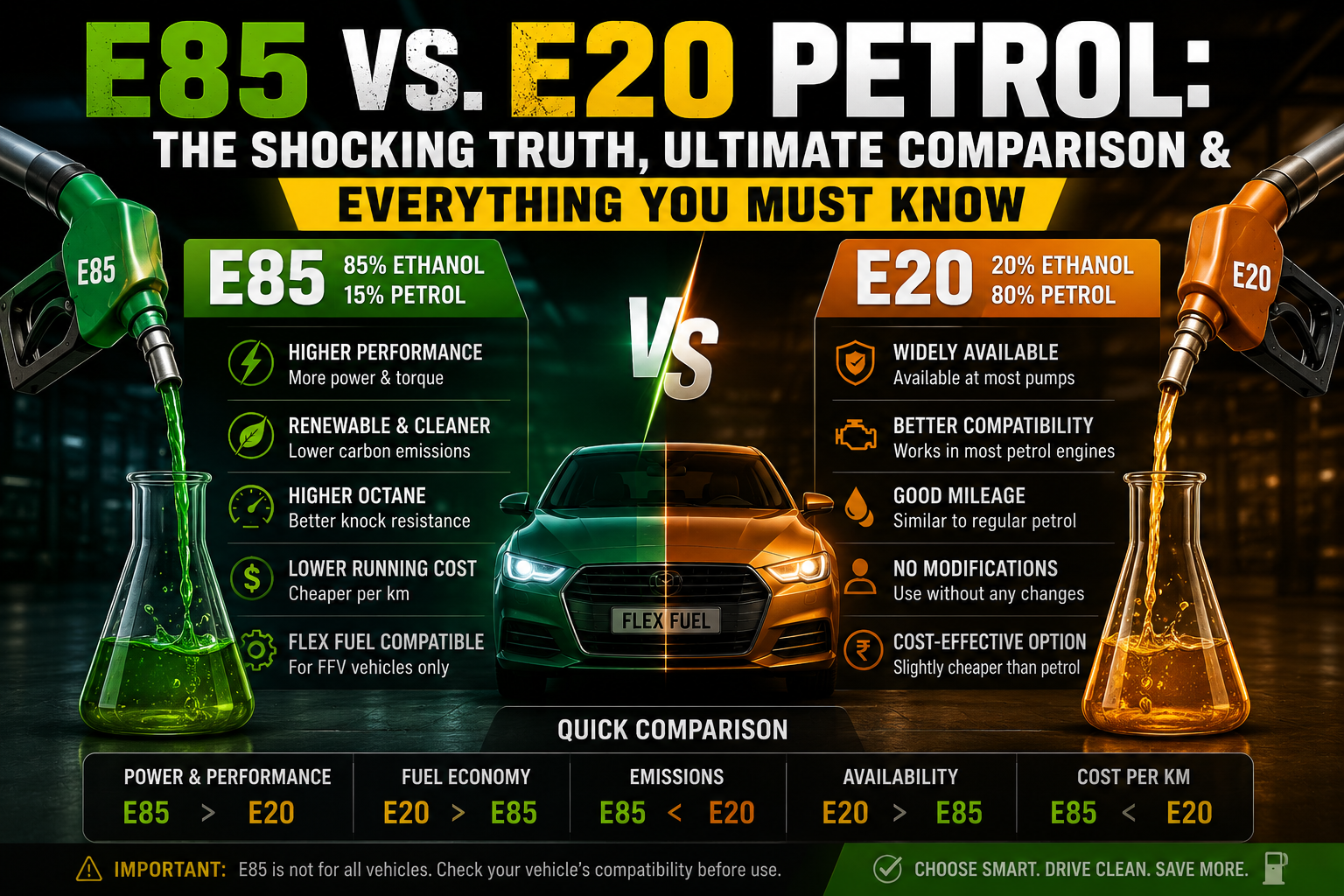
E85 contains 85% ethanol and 15% gasoline
It has a high octane content (from 95 to 100), but a low energy density. E20, on the other hand, consists of
20% ethanol and 80% gasoline
Because it has a mid-range octane rating (of 85 to 87), it is widely distributed throughout India and serves as an alternative fuel for most new petrol engine-based vehicles.
Ethanol is added to gasoline during refining. When using greater than E20 fuel blends, you need to have a petrol engine that can handle the additional amount of ethanol; otherwise, you run into issues and/or leaks that are caused by corrosion.
Ethanol blends are promoted by governments in an effort to reduce their dependence on imported oil, reduce emissions, and support the agricultural sector.
The Evolution of Ethanol Blended Fuels
Ethanol blends have emerged as a major strategy for reducing dependence on oil since early ethanol research during the 1970s. E100 programs were implemented throughout Brazil, while FlexFuel cars became popular across America, along with expanding use of E20 in India (with gas stations increasing availability and car compatibility for 2020+ year model vehicles). In addition to mainstream use of E85 in the Midwest and Brazil, E20 has been established as a national priority in India.
E85 vs. E20 Petrol vs Regular Petrol: A Complete Comparison
- Energy Density Comparison:
E85 ~27%-30% lower energy density than gasoline
E20 has slightly lower energy density than gasoline.
- Fuel Economy Comparison:
E85 15%-30% lower fuel economy than gasoline.
E20 is similar to gasoline in fuel economy.
- Price Comparison:
– E85 Generally 20%-40% less per liter than gasoline
– E20 Generally 3%-8% less than gasoline.
- Availability Comparison:
– E85 Available in limited locations, new E20 stations are rapidly opening across India.
Why E85 Deliver More Power – but Comes With Trade- Offs
The high octane rating of E85 enables you to use advanced ignition timing in your tuned engine giving you possibly 10 – 20% more power; however E85 is corrosive to engines not designed for it and will also result in a more difficult cold start, and lower fuel economy. E85 can only be used safely in FlexFuel vehicles.
Why E85 Delivers More Power—but Comes With Trade-Offs
- E85 markets: US Midwest, Brazil, a few select locations in Europe.
- E20 markets: India (expanding), Southeast Asia and South America.
- Eligible vehicles: E85 = FlexFuel only; E20 = most vehicles manufactured after 2020 in the Indian market.
- Price trend: E85 cost per litre is lower than that of gasoline. E20 is less expensive than gasoline by small variable amounts.
- Future for E30/E40 blends is currently being researched for potential production and sales.
Key Feature and Benefits of Each Fuel Type
Read also : Gears of War E-Day: Shocking Story Twists, Ruthless Gameplay, and Everything Revealed
- E85: is a high-octane fuel with potential for performance boosts; has low cost/litre and is renewable.
- E20: is currently widely available; can be used in modern cars; will give better fuel economy than E85; is supported by the government of Australia.
- Regular unleaded petrol: Provides reliable performance; has wide availability; and is more expensive/litre than other fuels in some areas of Australia.
Vehicle Compatibility Guide: FlexFuel and E20-Ready Cars
E20 Compatibility with Vehicles
All vehicles that were manufactured after 2020 for the Indian market will most likely work with E20 (when in doubt check your owner’s manual).
Using E85 in Non-Flex Fuel Cars
The usage of E85 in cars that cannot receive E85 will severely damage seals, fuel lines and injectors.
Determining Compatibility of E85 Fuel with Your Vehicle
You can determine if your vehicle is compatible with E85 gasoline by doing one of the following;
Check for a Flex Fuel Badge
Look in the owner’s manual
Call the manufacturer or dealer of your vehicle
Government Ethanol Programs and Key Highlights
The Official Fuel Program has a display to show:
- The ethanol blend percentage and octane numbers
- How the cost of fuel by E85 compares to regular gas based on distance traveled
- Where to find E85 fuel stations
- Compatibility of E85 gasoline with certain types of automobiles
- Environmental impact of Ethanol blended fuels
Real-World Performance and User Experience
According to empirical testing, the following is true about E85 and E20 gasoline compounds:
- If you are driving a modified Flex Fuel vehicle, E85 provides a significant power benefit but it has a decrease in miles per gallon than E20 gasoline.
- Both E20 and regular unleaded fuel have the same performance characteristics.
- Using E85 in a Non-Flex Fuel automobile creates excessive wear on the engine and difficulty with cold starts.
- Almost everyone owning a modern car would find using E20 to be safe and practical.
Essential Characteristics of E85 and E20
- Real-time Damage and Repair: Ethanol Can Corrode Non-Compatible Seals and Hoses.
- Dynamic Stealth: Dynamic stealth does not apply; however, Cold Starts are affected by fuel volatility.
- Environmental Impact: E85 has a Lower Life-Cycle CO2 Emissions and E20 has a Moderate Reduction in Life-Cycle CO2 Emissions.
- Stamina and Suppression: E85 Has a Lower Energy Density, Which Means Lower MPG; E20 is Very Close to Gasoline MPG.
Performance, Fuel Economy, Cost, and Safety Analysis
E85 Provides More Octane and Potential For Power
But Less Fuel-Efficiency Than E20, And Still Very Limited Availability of E85 Pumps.The Cost-Per-Km Will Usually Be Better With E20 On Non-Flex Fuel Vehicles, But E85 Can Provide Savings To High-Mileage Flex-Fuel Vehicle Owners.
Advantages and Disadvantages of E85 and E20
| Aspect | E85 Pros | E85 Cons |
| Fuel | Higher octane, power boost, lower per-liter cost | Lower economy, limited pumps, compatibility risk |
| Aspect | E20 Pros | E20 Cons |
| Fuel | Widely available, safe, better economy | Slightly lower power, small price premium |
FAQ
What is the main difference between E85 and E20 petrol?
The biggest difference is the ethanol content. E85 contains up to 85% ethanol, while E20 contains 20% ethanol. E85 offers a higher octane rating and better performance potential, whereas E20 provides better fuel efficiency for most vehicles.
Can I use E85 in any car?
No. E85 is designed specifically for FlexFuel vehicles (FFVs). Using it in a standard petrol vehicle can lead to engine and fuel system issues.
Is E20 safe for older vehicles?
E20 is generally safe for most vehicles manufactured after 2010. However, some older vehicles may experience compatibility problems with fuel system components such as seals and hoses.
Does E85 provide better fuel economy than E20?
No. Because ethanol contains less energy than gasoline, E85 typically delivers 15–30% lower fuel economy compared to E20.
Which fuel is more cost-effective: E85 or E20?
While E85 is often cheaper per liter, E20 usually offers better value per kilometer driven for vehicles that are not designed to run on high-ethanol fuels.
Will E85 improve my vehicle’s performance?
Yes, E85 can increase power output in FlexFuel vehicles or specially tuned engines. In some cases, performance gains of 10–20% are possible due to its higher octane rating.
Where can I find E85 fuel stations?
E85 availability is still limited and is most common in the United States Midwest, Brazil, and certain European countries. Fuel station locator apps and online maps can help you find nearby E85 pumps.
Is E20 widely available in India?
Yes. E20 fuel is becoming increasingly available across India, with many fuel stations adding E20 pumps as part of the country’s ethanol blending initiative.
Can E85 and E20 be mixed in the same fuel tank?
Only FlexFuel vehicles are designed to handle varying ethanol blends safely. Standard petrol vehicles should avoid mixing E85 with E20 or regular petrol.
What happens if I use E85 in a non-FlexFuel vehicle?
Using E85 in a non-FlexFuel vehicle can cause damage to fuel system components, including seals, fuel lines, and injectors, due to the higher ethanol concentration and its corrosive properties.
Conclusion
E85 versus E20 gasoline is based on your vehicle’s compatibility, driving patterns, and priorities. Although E85 provides increased octane as well as the potential for power, it has less efficiency than other fuels and currently has very few facilities selling it. E20 is cheaper/more widely available than E85 and is compatible with modern vehicles.
You should research your vehicle’s listed capability to use either type of fuel before comparing the prices of both E85 and E20 and selecting your fuel based on the type of driving you do. Provide subscription information to receive tips on fuel purchases, vehicles in general, and information regarding ethanol blended fuels; share this information with others who drive so that they too can gain from this knowledge.gaming guides, and subscribe to newssy.in
.