




API Basics Explained: How APIs Work for students
Introduction: APIs appear as intimidating tech jargon at first, but behind the scenes, APIs drive most apps on your phone today. APIs help apps in things such as Instagram logins or UPI...

Introduction:
APIs appear as intimidating tech jargon at first, but behind the scenes, APIs drive most apps on your phone today. APIs help apps in things such as Instagram logins or UPI transactions, or in the display of weather apps or chatbots. As a college-going individual who perhaps has some knowledge about programming (or is aware of apps in general) and keeps encountering buzzwords such as “REST API”, or perhaps “endpoints”, or maybe “JSON”, worry not! This article will finally decode what APIs mean and how they actually work in layman terms. After reading this guide, not only will you know the basics about APIs, but also make use of APIs in your projects.
Table Of Content
What Are APIs?
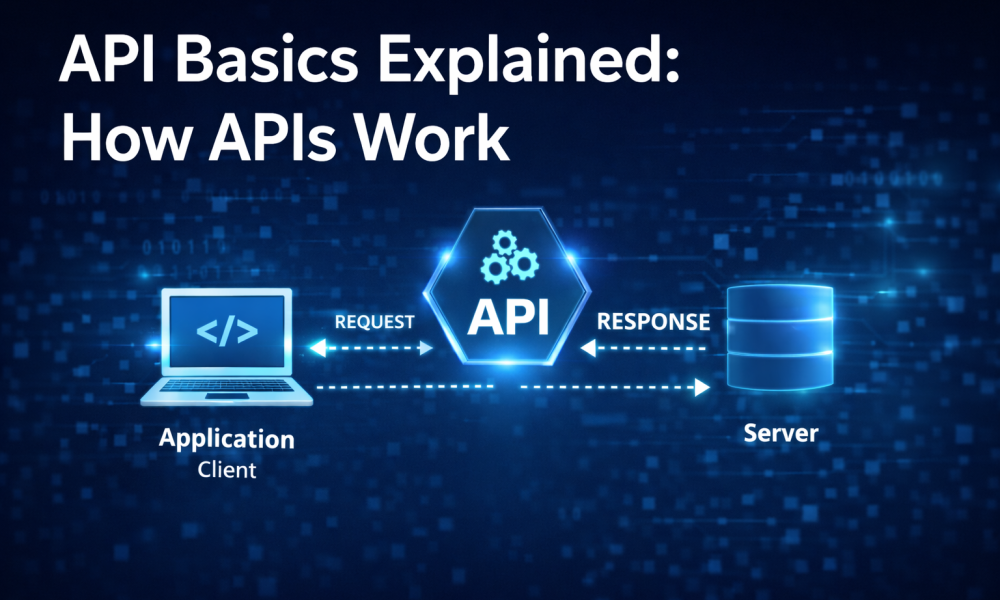
API (Application Programming Interface) is a bridge which allows two programs to communicate with each other. Like a menu card at a restaurant for ordering food without going into the kitchen, an API helps your application fetch data or perform an action from another system without going into its code. In most cases when you check today’s temperature through your weather app or see your scores through a game, it is making an API call in the background.
How Do APIs Work?
At a high level, APIs are based on a simple client-server paradigm: one side is the “client,” which sends a request, and the other is the “server,” which responds to the request with a response. A typical web API request would include the endpoint URL, the HTTP operation to be completed (for example, GET, POST, etc.), some data, and would return a response with its status code (for example, 200, which means that it was a success) and data, which may be in a JSON format. When, for example, your app asks the API: “Can you give me the current weather in Chennai?” The server responds with the data, which is formatted in a way that is easily viewable in your app.
Common Types of APIs Students Will Hear About
Almost all the work at the college level is associated either with web APIs or HTTP APIs, which utilize web protocols (HTTP or HTTPS) for the sending and receiving of data from clients and servers. Perhaps the most common form of web API for beginners is the REST API style. This is made up of ”resources“ such as /students/, /orders/, or /posts/, which can be INSERTED, RETRIEVED, UPDATED, or DELETED using the appropriate HTTP method. As a student, the need to learn about other types first may not be essential.
Key API Concepts: Methods, and JSON
HTTP verbs such as GET (for read), POST (for creation), PUT (for update), or DELETE (for deletion) communicate what action is supposed to be performed on the resource. Many modern APIs exchange information in the JSON format, which are essentially key-value pairs that are very easy to read and understand in programming languages such as JavaScript or Python.
Why APIs Matter for College Projects and Careers
Read also :Mutual Funds vs Fixed Deposits in India: Which Option Should Beginners Choose?
In the aspect of mini-projects, APIs allow you to incorporate “powerful” functionalities such as real-time weather, news, maps, and AI capabilities without having to develop complex systems yourself. APIs can instantly increase the “real-world” quality of your projects, which can come in handy in hackathons, viva, internship, and/or portfolio assessment situations. In most programming job requirements for most modern software-related tasks, such as web, mobile, server, and/or data programming, API familiarity is now basic.
Step-by-Step: How to Call an API as a Beginner
The easiest way to get started will be to choose some free public API-something like a joke API, quotes API, or some super simple weather API that doesn’t require complicated authentication. First, open its documentation and note the base URL, endpoints, parameters, and example requests shown there. Then, test a simple GET request in your browser or with a tool like Postman, and finally call the same endpoint using fetch in JavaScript or requests in Python to print the JSON response.
Practical API Use Cases for College Students
Using APIs in web development projects, you can create the application of your choice, say weather dashboard, movies search engine, currency converter, or simply a student portal using the backend API. When developing mobile applications, APIs can enable you to perform actions like retrieval of live feeds, maps, log in details, and payments, giving your Android and iOS applications the effectiveness of products that are fully functional and “ready for the market.” You can also implement applications of artificial intelligence, “translation,” and cloud using the APIs of platforms like AWS, without needing to know machine learning programming.
Common API Terms Explained (Auth, Status Codes, Rate Limits)
There is often a need for API authentication with a user’s API keys or a token similar to a password, enabling identification of the application making the API call and its usage level. Status codes such as 200, 404, or 500 facilitate evaluation of the status of an API request or a problem that might have occurred, as needed for debugging purposes. Some other APIs are based on the concept of rate limiting, enabling a user to make a predefined number of calls in a minute or a day.
Beginner Mistakes to Avoid with APIs
A very common mistake is skipping the documentation and randomly changing URLs or methods, which leads to confusing errors and wasted time. Many beginners also copy API keys directly into public GitHub repositories, risking misuse or unexpected charges on their account. Another trap is trying to learn every API style and language at once; it’s usually better to master one simple REST API and one language before expanding.
Mini Roadmap: How to Get Good at APIs in College
Begin by consuming one or two introductory videos and make two or three calls to a public API using Postman and a simple script in JavaScript or Python. Then, incorporate at least one API call into your class assignments or hackathons, such as a search feature, live data, or a login system. After you feel confident, learn how to create a simple API using tools such as Node.js or Express.js and similar technologies.
FAQ Section (Questions with Answers)
- What is an API in simple words for college students?
An API is a software bridge that lets one program talk to another and request data or actions, like an app asking a server for information over the internet. - How do APIs work in websites and mobile apps?
Websites and apps send HTTP requests to API endpoints, and the server responds with data (often JSON) that the app uses to update screens without you seeing the behind-the-scenes work. - What is the difference between an API and a website?
A website is meant for humans to read and click, while an API is meant for software to consume structured data and actions, usually without a graphical interface. - What is a REST API and why is it important for beginners?
A REST API follows simple rules using URLs and HTTP methods (GET, POST, PUT, DELETE) to manage resources, making it the most common and beginner-friendly style of web API today. - Do I need to know programming to understand how APIs work?
You can understand the basic idea of APIs without coding, but to actually use them in projects, you should know at least one language like JavaScript or Python. - How can I practice calling APIs as a student?
Start with free public APIs, use Postman or your browser for GET requests, and then write small scripts to call those APIs and print the results. - What are API endpoints, HTTP methods, and status codes?
Endpoints are specific URLs, methods describe actions like GET or POST, and status codes are numeric responses that show whether your request succeeded or failed. - What is an API key and is it safe to share it?
An API key identifies your app to the API provider and should be kept secret; never share it publicly or push it to open GitHub repositories. - Which language is best to start learning APIs with?
Most beginners find JavaScript (with fetch) and Python (with requests) the easiest languages for learning how to work with REST APIs. - How can I build my own simple API as a college project?
You can use frameworks like Node.js with Express or Python with Flask/Django to create endpoints that return JSON data, then connect them to a simple front-end or mobile app.
Conclusion: APIs as Your Superpower in Tech
At first, APIs might seem like a mess of URLs, JSON, and status codes, but once you learn the pattern, they become one of the most empowering tools in your entire developer journey. Instead of having to build everything from scratch, you can plug into powerful services like payments, maps, AI, and more to sit back and focus on solving real problems in your projects and future products. Think of APIs as the “language” apps use to talk to each other-the more fluent you become, the easier it gets to build smart, connected experiences that stand out in internships, hackathons, and job interviews.So, what do you think? Let me know in the comments. And if you found this article helpful, share it with your friends.“Every error message is just a new lesson in disguise”for more tech news subscribe newssy.in–Google Maps Icons and Symbols: What They Mean ?







No Comment! Be the first one.