




Bank Fixed Deposit Interest Rates 2025
If you are searching for the bank fixed deposit rates for the year 2025, then you are in good company. The buzz about fixed deposits has been doing the rounds everywhere – from WhatsApp groups to...

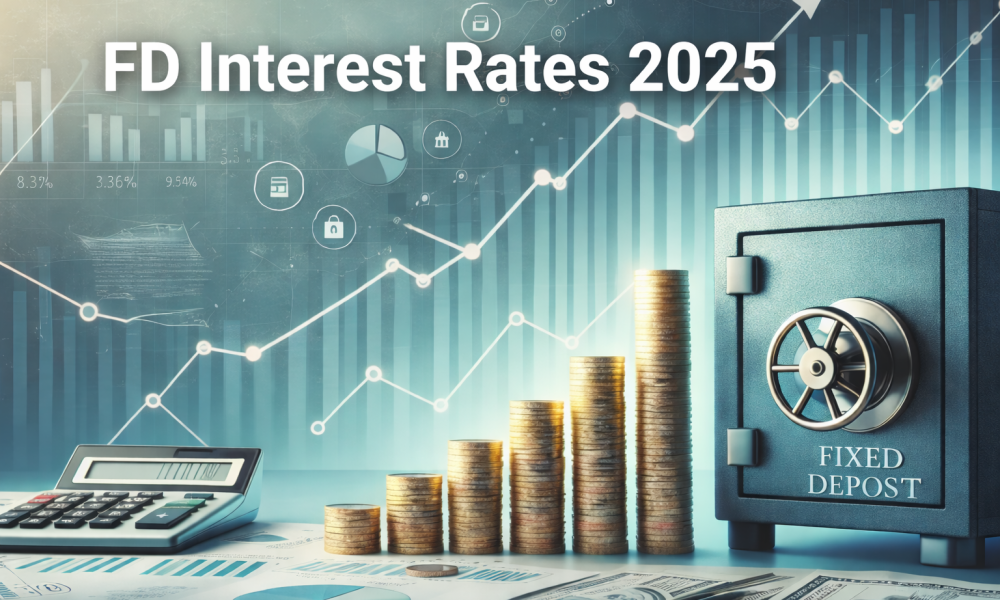
If you are searching for the bank fixed deposit rates for the year 2025, then you are in good company. The buzz about fixed deposits has been doing the rounds everywhere – from WhatsApp groups to discussions in the pantry. Whether it is conservative senior citizens or young working professionals, everybody is trying to find out which bank will provide them with the safest and highest returns in the year. So, what actually awaits bank fixed deposits in 2025? Let’s explore.
Table Of Content
- Key Highlights
- Bank Fixed Deposit Interest Rates 2025: What is Really Going On?
- Why Are People Obsessed with Bank Fixed Deposit Interest Rates in 2025?
- 1. Safety First Mindset
- 2. Changing RBI Repo Rate, Changing FD Rates
- 3. Search for “Better Than Savings” but “Safer Than Stocks.”
- FD Basics – The Simple Agreement Behind Those Numbers
- Bank FD vs NBFC & Small Finance Bank FD – The Human Trade‑Off
- The Quiet Enemies: Inflation, Tax, and Mistakes
- 1. Inflation
- 2. Tax
- 3. Human Mistakes
- Using Bank Fixed Deposit Interest Rates 2025 Smartly – Not Emotionally
- Final Thoughts
Key Highlights
- Bank fixed deposit interest rates for 2025 typically range around the mid-single digits annually, with the best rates usually in the 1–3 year tenure range.
- Small finance banks and select NBFC FDs often offer higher rates than large banks, but they come with different levels of risk and require careful evaluation.
- RBI has cut the repo rate in 2025, keeping the benchmark policy rate near the lower end of the recent cycle, which has gradually pushed FD rates down from earlier peaks.
- Senior citizens generally earn about 0.25–0.75% p.a. extra on fixed deposits compared with non‑senior customers, and some banks run special senior schemes.
- Bank FDs remain one of the safest, simplest ways to park money, but inflation and taxes can quietly reduce real returns over long periods.
- 5‑year tax‑saving FDs under Section 80C offer tax deductions on the principal up to the allowed limit, but come with a strict lock‑in and taxable interest.
- FD laddering – splitting money into different tenures – helps manage changing interest rate cycles and improves liquidity without breaking FDs.
Bank Fixed Deposit Interest Rates 2025: What is Really Going On?
We have to be blunt – the interest rates offered by banks on their Fixed Deposits in 2025 have become an emotional subject in most households. A couple of years back, the interest rates on FDs seemed quite lucrative; but now that the government has made a few changes in the policy rates, people realize that their best “safe” option is not giving them the expected returns anymore. The major banks have cut their FD card rates significantly on popular terms of 1 year, 2 years, and 3 years, and the best rates lie in the special schemes with “odd-day” terms.
The underlying cause of this has been the policy stance of the RBI. When the RBI cuts the repo rate, which is the rate at which it loans money to banks, borrowing becomes cheaper; as a result, the loan cost comes down; in turn, the rate of deposits comes down. This is the reason why many people feel as if “rates keep slipping” in comparison with the rates their parents used to enjoy.
But for the average investor, it can be made clear that you cannot time the interest rate cycle but can time how intelligently you can make use of the current FD rates.
Why Are People Obsessed with Bank Fixed Deposit Interest Rates in 2025?
Perhaps you are asking, “Why have people begun bringing up FD rates again?” Below are the true reasons why this is a major topic that keeps popping up during our conversations.
1. Safety First Mindset
Bank FDs occupy a unique emotional sweet spot in India; they feel safe, familiar, and trustworthy. Most people’s first exposure to “investing” is not the stock market; it is the FD that their parents opened in their name when they were children. Even today, when markets get volatile or scary headlines appear, money often flows back into FDs because depositors want stability and peace of mind.
When you choose FDs in 2025, you are not just picking a number; you are buying the comfort of knowing exactly how much you will receive at maturity, regardless of market ups and downs.
2. Changing RBI Repo Rate, Changing FD Rates
The RBI repo rate in 2025 is lower than in some previous high-rate years, and every move by the central bank slowly ripples into FD rates. A cut of 25 or 50 basis points may sound small on TV, but when banks reprice millions of crores of deposits, it can make a noticeable difference to the interest you earn.
People follow these changes because they directly impact retirees’ monthly income, fixed‑income portfolios, and even how much risk families are willing to take in other products.
3. Search for “Better Than Savings” but “Safer Than Stocks.”
Many savers are looking for something that pays more than a savings account but does not swing like equities. Bank, NBFC, and small finance bank FDs are in this middle zone. This is why terms like “best FD rates in India 2025”, “highest bank FD interest rate”, and “FD vs debt fund” are so heavily searched – people are actively trying to fine‑tune this middle layer of their portfolio.
FD Basics – The Simple Agreement Behind Those Numbers
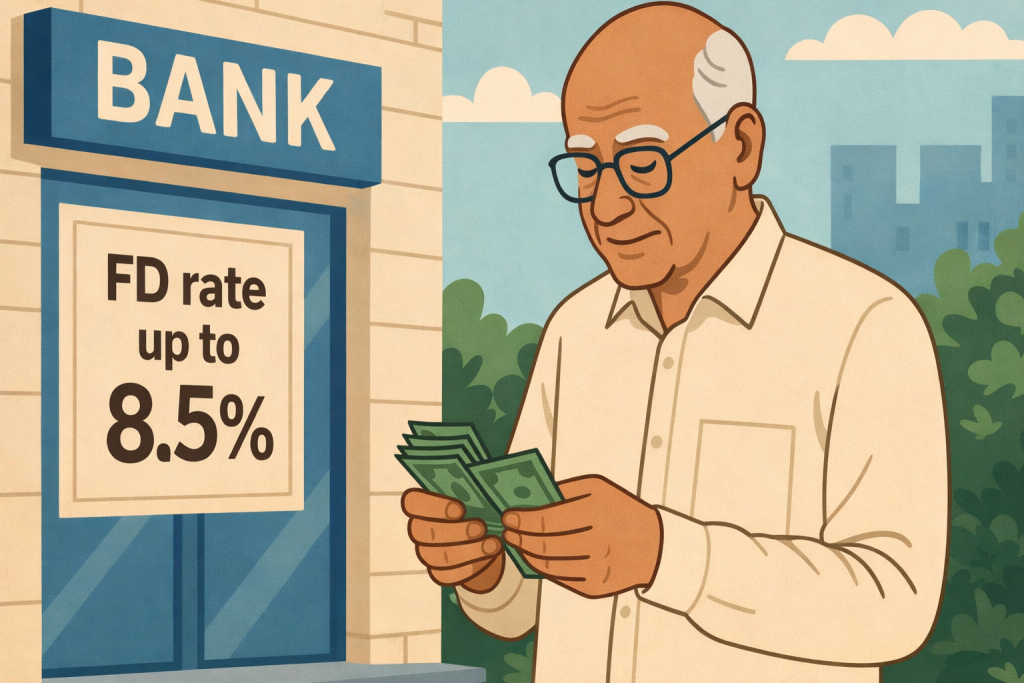
Even if you already have FDs, it helps to see them with fresh eyes in 2025.
A bank fixed deposit is a straightforward promise: you give the bank a lump sum for a fixed period, and the bank commits to paying you a fixed interest rate and returning your principal at the end of that tenure. Unlike your savings account rate, which can change often, an FD rate is locked on day one – which feels reassuring when the outside world is noisy.
Some core concepts to keep in mind:
- The principal is the initial amount.
- The interest rate is what you earn per year on that principal.
- Tenure is the duration for which the money is locked; it can be days, months, or years.
- The maturity amount is the principal plus interest paid at the end of the cumulative FDs.
- In non-cumulative FDs, interest can be paid monthly or quarterly as regular income, which is useful for senior citizens.
Once you see FDs as a simple contract, comparing banks and schemes becomes less confusing and more like shopping for the best value at a grocery store, albeit with bigger stakes.
Bank FD vs NBFC & Small Finance Bank FD – The Human Trade‑Off
A higher rate of interest is always tempting in the calculation sheet. Your heart calculates “extra income per year” in the blink of an instance if you see that a small finance bank/NBFC is offering your well-known big bank an interest rate of 0.75-1% higher. But the actual question is not “How much income will I earn?” but “What risk am I silently taking to earn that income?”
The Bank FDs are insured with a maximum of Rs 5 lakhs in the event of a bank default. An NBFC/Corporate FD has monetary regulations; however, the emphasis here is on the financial credibility of the company itself. There is no scale of deposit insurance in this scenario.
What this is not saying is “Never invest in NBFC FDs,” but it is also saying that:
Maintain your emergency and non-negotiable funds in high bank Fixed Deposits.
You can use highly rated NBFC/FD small finance banks only for your surplus funds that you can afford to invest for the entire term.
Always read the rating and credit background, rather than simply trying to get the highest number.
It is a question of where you store your jewels. A locker in a bank versus a place you are not so familiar with. The additional 0.5 percent isn’t worth losing any sleep over.
- Keep emergency and non-negotiable money in strong bank FDs.
- Use high-rated NBFC or small finance bank FDs only for surplus money you can afford to park for the full term.
- Always read the rating and issuer background instead of blindly chasing the highest number.
The Quiet Enemies: Inflation, Tax, and Mistakes
Even in 2025, many people still see the FD interest rate and stop thinking after that. However, three quiet forces can change the real picture.
1. Inflation
If your FD pays around the same percentage as inflation, your real growth is close to zero; your money feels safe but does not become more powerful over time. For short‑term goals, that is fine; for long‑term dreams like retirement or a child’s higher education, it can be dangerous.
2. Tax
FD interest is fully taxed as per your slab, whether you withdraw it or roll it over. For people in higher tax brackets, a 7% FD can quickly become a much lower post-tax return, especially when TDS and final tax liabilities are considered. That’s why some investors mix tax‑efficient products (like PPF or ELSS) with FDs instead of relying on FDs alone for everything.
3. Human Mistakes
- Forgetting maturity dates and letting FDs auto‑renew at lower rates.
- Booking senior citizens as regular customers and losing extra interest.
- Breaking FDs early and paying penalties because the tenure was chosen randomly.
These are small errors on paper, but over the years, they have cost families thousands of rupees in lost interest.
Using Bank Fixed Deposit Interest Rates 2025 Smartly – Not Emotionally

The heart of smart FD investing in 2025 is to avoid extremes. Do not be the person who dumps all money into long‑term FDs just because “rates look okay today,” and do not be the person who avoids FDs completely because “returns are not exciting.”
A calmer and more balanced approach is as follows.
- Match each FD to a clear goal and time frame instead of random tenure.
- Spread money across different durations using an FD ladder so that some amount matures every year and can be reinvested at new rates.
- Keep core safety funds in top bank fixed deposits (FDs); use only a limited portion for higher-yield non-banking financial companies (NBFC or small finance bank FDs.
- Consider your tax slab and inflation whenever you look at “real” return, not just the brochure number.
When you treat FDs as an important piece in your overall financial puzzle – not the entire puzzle – your decisions automatically become more rational and less stressful.
Final Thoughts
Bank fixed deposit interest rates in 2025 do not have the drama of multibagger stocks, but they offer their share of something equally good: stability and predictability. In a year when headlines have kept changing and markets can get moody, the FD does its job, silently, in the background.
As a conservative saver, a senior citizen, or someone just starting your money journey, one evening is well spent on understanding the basics of FD, current trends in rates, and simple strategies such as laddering, which can greatly improve your financial calm. The next natural step can be to slowly explore other options, such as mutual funds and SIPs, which help the long‑term money grow faster than inflation without abandoning the safety net that FDs provide.
Now, what do you think? Are you going to review your existing FDs this week, check the latest rates from three to five banks, and possibly restructure them a bit? If this breakdown helped clear the noise around the FD interest rates in 2025, do share it with that someone in your family who still thinks, “FD hi sabse best hai,” without seeing the full picture. And if you found this article helpful, share it with your friends. Investing is always better when you learn together. for more finance news subscribe newssy.in





No Comment! Be the first one.